Pitching Rate Theology

Finding consistent and credible information on yeast pitching rates is a bit like religious theology. Trying to find out how many yeast cells are in a pouch of yeast is like trying to find out how many angels can dance on the head of a pin! A lot of people agree, but when they disagree, it's passionate and usually by a long margin. I would really love to understand precisely how much yeast to pitch, how to manage to keep it healthy and happy, and ultimately make excellent beer.
First, dry versus liquid yeasts... I always select the yeast appropriate to a given style, then move to convenience. Frankly, I do not care to make starters unless necessary - and it is usually essential for me when I use liquid yeast. At $7.00 a vial or smack pack, I am not all that interested in investing $21-28 bucks just for a viable healthy pitch of convenience. So then I have to make a starter, and this must work back from my planned brew day - say start 4 days ahead and pray I can reserve the dedicated time to brew. I am a huge fan of dry yeast and its convenience, however, the limitations of strains are a problem. Liquid or dry - yeast pitches should be the same, assuming good health and viability.
For the anti-starter types and the pitchers of dry yeast into wort, I have found that starters and/or hydration produce the best and consistent fermentation in my brewing. If an easier path works for you - awesome. I don't think you should read further!
For convenience's sake, homebrew supply stores have reduced pitching yeast to a common denominator: 1 sachet of dry yeast for 5 gallons of normal-gravity beer, double for higher-gravity beer. Same with liquid yeast. This results in wildly differing pitch rates and a potential source for homebrewer mythology. One can read the thousands of "my beer is stuck" posts on Homebrewtalk.com and see that one package or vial of yeast in 1.110 wort is going to be troublesome...
Regardless of packaging or medium (liquid versus dry) we should attempt to pitch the CORRECT amount of yeast to see consistent and reliable results.
Sean Terrill's blog has some interesting experiment results, and his findings of 8 - 18 million cells per gram support MrMalty.com's assertion that there are approximately 20 billion cells per gram of dry yeast, so in a 11.5 gram sachet, there should be approximately 230 billion cells, however Lallemand claims only 6 billion cells per gram, resulting in 69 billion cells per sachet, and in fact tables are floating around the internet of WIDELY varying cell density. That is a HUGE discrepancy, and I use the manufacturer's numbers personally - and maybe overpitching. In a White Labs vial or a Wyeast Smack Pack, there are approximately 100 billion cells. Good general working numbers.
Viability needs to be understood, meaning that yeast will die off in the packaging over time, reducing the overall viable cells. These vary with time, temperature, and handling. As such, check the dates, and use a calculator to determine the remaining number of potential viable cells. I should add that packaging may dictate the use of weight in grams (dry) or volume in milliliters (liquid, slurry). You want the freshest yeast possible. Here dry again wins me over - being SLIGHTLY more stable, and certainly longer lived. It is always in stock in my fridge.
We need to determine the correct amount to pitch in relation to the specific gravity of our wort. First determine gravity, and then wort volume, as the math becomes easier. Then go back to our manufacturer and determine the package's pitch density.
(pitching yeast density in millions/ml) X (milliliters of wort) X (degrees Plato of the wort) = total pitch yeast cells
In the book "Yeast" (great book btw) - Chris White and Jamil Zainasheff propose that 1 million cells per ml is the generally accepted pitching rate, but that .75 million cells for ale and 1.5 million cells for lagers is more appropriate (per milliliter). I see no distinction between professional and homebrewer-scaled pitching in their recommendations. We are dealing with yeast, and they don't know the brewer's skill level. Master brewers will adjust pitching rates to push the yeast to produce a specific flavor or attenuate higher or lower, as another tool in their bag of tricks.
If you look at Brewer's Friend's Yeast Pitch Rate and Starter calculator, there is a drop-down for "Pro" settings that range from 0.75 to 1.25 million cells/ml for ales, and step up to 1.5 to 2.0 million cells/ml for lagers. Above that are significantly lower manufacturer recommendations at .35 and .5 million cells/ml, respectively. I find it fascinating that there is such a wide range of recommendations, which confirm that brewers pitch at dramatically different rates, and that it is convenient for homebrewers looking for a quick setting for their special beer.
Into the math for my recent "Houston We Have a Pale Ale Part Deux," where the gravity was 1.061 in the fermenter. This equates to 14.66 degrees Plato. I am going to pick a 1.0 million cells/ml Pro pitching rate in Brewer's Friend Yeast Calc, since I am past the 1.050 gravity line. We have an 11-gallon batch, which equals 41639.8 ml of wort.
(yeast density in millions/ml) X (milliliters of wort) X (degrees Plato of the wort)= Required cells to pitch
(1,000,000 million/ml cells) X (41639.8 ml wort) X (14.66 degrees Plato) = 610,439,468,000 required cells, or round to ~610 billion cells
I used Danstar's BRY-97 West Coast Ale, which documents about 5 billion cells per gram in an 11-gram package. This would equal 55 billion cells per sachet. This is much lower than the assumed 20 billion cells per gram reported by MrMalty.com.
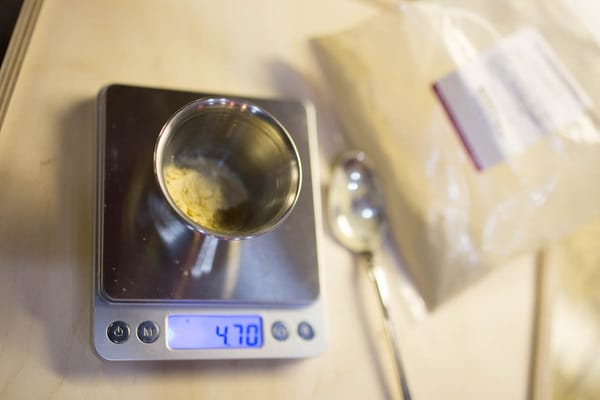
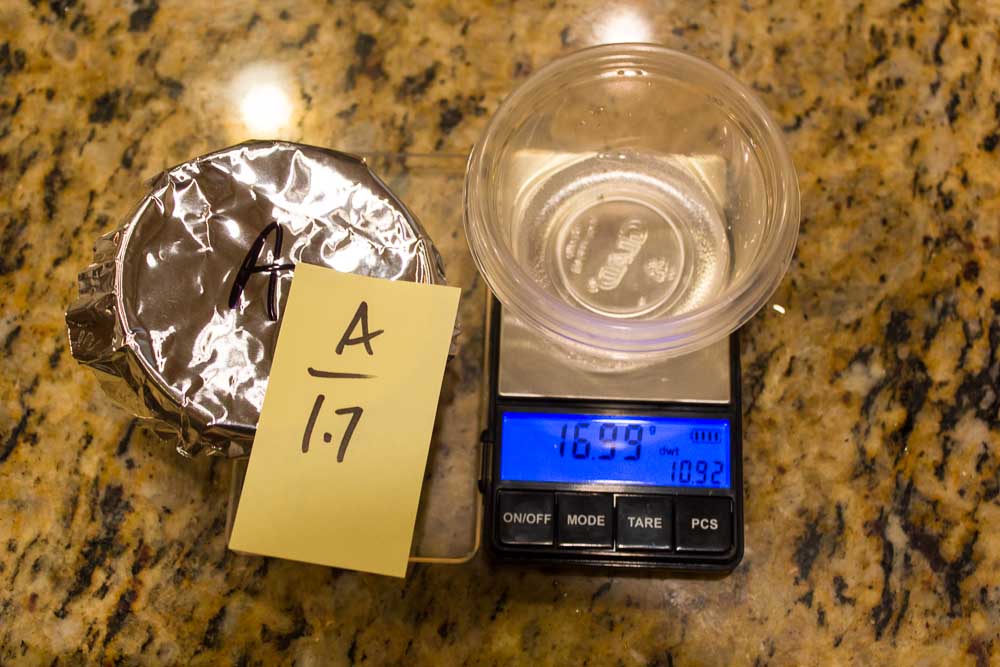
610 billion cells required = 122 grams of BRY-97, roughly 11 sachets. Now, I carefully weigh that, and following instructions, rehydrate in 1220 grams of warm sterile water and let sit. After 15 minutes, stir gently, adjust the temperature to the wort temperature, and pitch. In my case, I built a 2-step stir plate starter to achieve an adequate cell count. While that is generally not recommended for dry yeast, it worked fine in this instance and only took a few hours to achieve my goal.
My conclusion to this is the following:
Now... how many yeast cells can dance on the head of a pin? It depends on whether you believe the manufacturer or Mr. Malty. Now let's hope my math skills aren't so rusty that I made a huge mistake!